





Cacao capsules vs theobromine capsules may seem like two versions of the same supplement. Both are associated with Theobroma cacao, but they contain different types of ingredients. Cacao capsules use botanical material derived from cacao beans, while isolated theobromine capsules are formulated around a specific chemical compound.
Theobromine occurs naturally in cacao alongside caffeine, flavanols, and other constituents. An isolated theobromine product focuses on that molecule rather than the broader composition of cacao seeds.
Secrets Of The Tribe identifies organic raw cacao beans as the botanical ingredient in its Cacao Capsules. This establishes the plant source but does not provide a verified amount of theobromine per serving.
This comparison explains the differences between a cacao-derived botanical ingredient and an isolated compound, why capsule counts cannot establish equivalent quantities, and what to check before choosing either format.
Are Cacao Capsules and Theobromine Capsules the Same?
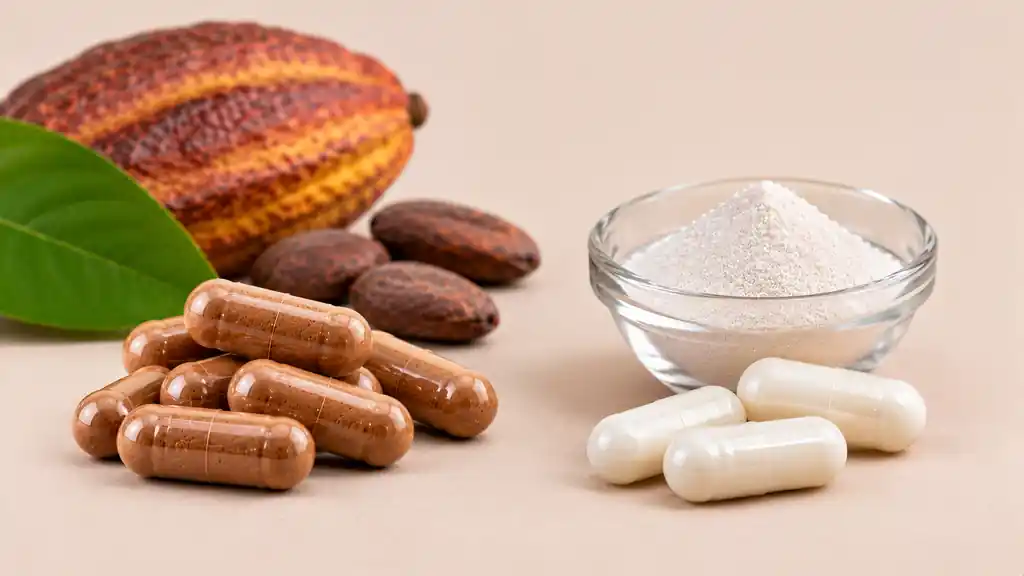

No. Cacao capsules contain cacao-derived botanical material, while isolated theobromine capsules contain a preparation centered on theobromine itself. Their ingredient composition and the amount of theobromine provided per serving may differ substantially.
Both products can come in capsules, but a similar appearance does not indicate an equivalent formulation.
Quick Comparison: Botanical Ingredient vs Isolated Compound
|
Characteristic |
Cacao Capsules |
Theobromine Capsules |
|---|---|---|
|
Primary ingredient |
Cacao-derived botanical material |
Theobromine |
|
Botanical association |
Theobroma cacao |
Compound naturally found in cacao |
|
Ingredient category |
Botanical preparation |
Individual chemical compound |
|
Plant material |
Cacao seeds |
Not necessarily whole plant material |
|
Theobromine |
Naturally occurring |
Primary named ingredient |
|
Caffeine |
Naturally occurs in cacao |
Not part of pure theobromine |
|
Cocoa flavanols |
May be present depending on processing |
Not inherent to isolated theobromine |
|
Ingredient quantity |
Botanical amount per serving |
Compound amount per serving |
|
Other constituents |
Depends on cacao preparation |
Depends on purity and added ingredients |
|
Equal capsule counts |
Do not establish equivalence |
Do not establish equivalence |
|
Direct substitution |
Not established |
Not established |
The table describes ingredient categories, not the exact composition of every commercial product. Specific formulations require individual label and laboratory verification.
What Do Cacao Capsules Actually Contain?
Cacao capsules contain material derived from cacao beans, which naturally include several groups of compounds. The exact profile depends on the botanical material and manufacturing process.
Theobroma cacao: Botanical Source
Theobroma cacao is a tropical tree belonging to the Malvaceae family. Its fruits contain seeds commonly called cacao beans.
These seeds are used to manufacture cocoa powder, chocolate, cacao paste, and botanical supplements.
Cacao seeds contain naturally occurring fats, proteins, carbohydrates, polyphenols, methylxanthines, and other constituents.
Theobromine in Cacao Beans
Theobromine is generally the predominant methylxanthine in cacao seeds. Caffeine also occurs naturally, usually in smaller quantities.
The relative amounts vary with the cacao variety, growing conditions, fermentation, drying, and processing.
Consequently, identifying cacao as an ingredient does not establish an exact quantity of theobromine in a finished capsule.
Other Naturally Occurring Compounds
Cacao also contains flavanols, including epicatechin and catechin, along with related procyanidins.
These compounds belong to the polyphenol family and are chemically different from theobromine.
The extent to which they remain in a finished capsule depends on the selected cacao material and manufacturing methods.
What Is Isolated Theobromine?
Isolated theobromine is the individual chemical compound 3,7-dimethylxanthine, rather than the complete mixture of constituents found in cacao beans.
Its molecular formula is C7H8N4O2. The compound belongs to the methylxanthine family, which also includes caffeine and theophylline.
A Single Identified Molecule
Theobromine has a defined chemical structure, regardless of whether it originates from cacao or another manufacturing process.
A product containing isolated theobromine is designed around that identified substance rather than the complete cacao seed matrix.
However, the presence of theobromine on a supplement label does not establish the purity of the finished ingredient without supporting documentation.
Natural Origin vs Manufacturing Source
Theobromine occurs naturally in cacao and certain other plants.
Its chemical name does not necessarily reveal whether a manufacturer obtained it through botanical extraction or another production method.
If ingredient origin matters, review the manufacturer’s sourcing and production information.
Additional Capsule Ingredients
Even a supplement marketed as isolated theobromine may contain capsule shell materials, processing aids, or other declared ingredients.
Check the Supplement Facts panel and the complete ingredient list instead of assuming that the entire finished capsule contains only theobromine.
Why Is Cacao Ingredient Weight Different From Theobromine Weight?
The weight of a cacao ingredient includes multiple constituents, while a declared theobromine quantity refers to one specific compound. These measurements cannot be used interchangeably.
Botanical Weight
A label listing 500 mg of cacao material describes the weight of that ingredient.
That weight may include botanical fats, proteins, carbohydrates, and multiple naturally occurring compounds.
It does not mean the capsule contains 500 mg of theobromine.
Isolated Compound Weight
A label declaring 500 mg of theobromine describes the stated quantity of that compound per specified serving.
This is a different measurement from the total weight of cacao bean material.
The example illustrates how labels communicate different quantities. It does not describe either product’s actual formula.
Why a Universal Conversion Does Not Work
There is no reliable universal conversion between a gram of cacao powder and a specific number of milligrams of theobromine.
Cacao composition varies naturally, and processing can change methylxanthine concentrations.
Any accurate comparison requires product-specific analytical information.
Does Isolated Theobromine Contain Cacao Flavanols?
Pure isolated theobromine does not inherently contain cacao flavanols because they are different chemical compounds.
Cacao flavanols include epicatechin, catechin, and related procyanidins. Theobromine belongs to the methylxanthine family.
A finished supplement could contain additional botanical ingredients, but those must be identified separately.
Botanical Mixtures
Cacao-derived preparations can contain several groups of naturally occurring constituents.
The relative quantities depend on whether the ingredient is a seed powder, extract, or another processed preparation.
Isolated Compounds
An isolated compound is separated or manufactured to provide a particular chemical ingredient.
Other components of the original plant are not automatically included.
This distinction is important because studies using cacao extracts, cocoa foods, or isolated theobromine may examine different preparations.
Do Cacao Capsules and Theobromine Capsules Contain Caffeine?
Cacao naturally contains caffeine, while pure theobromine is a chemically different substance. The finished products still require individual ingredient checks.
Caffeine in Cacao
Cacao seeds contain both theobromine and caffeine. Their concentrations vary by botanical source and processing.
A cacao capsule should not automatically be described as caffeine-free without product-specific evidence.
Caffeine in Isolated Theobromine Products
Caffeine is not a component of the theobromine molecule.
However, a commercial supplement may contain additional ingredients or residual substances depending on its formulation and manufacturing quality.
Check the complete label and available purity testing when caffeine exposure matters.
What Does the Cacao Capsules Product Listing Establish?
The published Cacao Capsules product listing identifies the botanical ingredient as organic Theobroma cacao raw beans.
The capsules are available in 60-count and 120-count bottles. The manufacturer describes them as vegan, non-GMO, gluten-free, and sugar-free.
The suggested use is two capsules twice daily with food.
These details establish the advertised botanical source, capsule format, and directions. They do not establish a quantified theobromine amount per serving.
The product listing also provides access to available batch-related documentation through a Product Passport system.
When examining this information, check whether the laboratory report specifically measures theobromine. General third-party testing does not automatically confirm the amount of every naturally occurring constituent.
Can You Compare Two Supplements by Capsule Count?
No. Equal capsule counts do not establish equal quantities of theobromine or other compounds.
Capsule size, ingredient weight, concentration, and serving instructions can differ between manufacturers.
One Capsule Is Not a Standard Dose
The term capsule describes the product format, not a standardized quantity of botanical material or an isolated compound.
A manufacturer may use different capsule sizes or recommend multiple capsules per serving.
Check Milligrams Per Serving
For a theobromine isolate, look for the declared amount of theobromine per serving.
For cacao capsules, check the botanical ingredient weight and whether the manufacturer provides a verified theobromine measurement.
These figures answer different questions and should not be compared as though they represent the same substance.
Can You Substitute Cacao Capsules for Theobromine Capsules?
No direct substitution should be assumed. The products differ in ingredient composition, and their actual theobromine quantities may not be comparable.
Someone interested in a cacao-derived botanical ingredient may consider cacao capsules made from organic bean material as a distinct product category rather than a substitute for isolated theobromine.
Someone evaluating an isolated compound should review its verified identity, concentration, purity, and serving directions.
The editorial position at Secrets Of The Tribe is that botanical ingredient weight and isolated-compound quantity should remain clearly distinguished. Neither product name nor capsule count establishes equivalence.
Do not increase a cacao capsule serving to match the stated amount of an isolated theobromine supplement. Such a calculation would require analytical information and an appropriate safety assessment.
What Quality and Safety Details Matter?
Both categories require careful review of product identity, ingredient quantities, and manufacturer instructions.
A concentrated isolated compound should not automatically be considered safer or more suitable than a botanical preparation. Conversely, a plant-derived ingredient is not automatically suitable for everyone.
Review the complete Supplement Facts panel and any available certificate of analysis.
For isolated theobromine, look for testing that confirms the compound’s identity and purity. For cacao, determine whether the available testing includes methylxanthine quantities and relevant contaminant checks.
If you are pregnant, nursing, taking medications, or have relevant health concerns, consult a qualified healthcare professional before using either supplement.
Follow the specific product’s serving directions. Do not combine or substitute formulations based on general cacao composition estimates.
Checklist: Comparing Cacao and Theobromine Capsules
These products can share a chemical constituent without having equivalent formulations. Use this checklist to identify the actual ingredient, understand the declared quantities, and review the information needed for a meaningful comparison.
1. Identify the Primary Ingredient
Check whether the supplement contains cacao-derived botanical material or isolated theobromine.
2. Read the Scientific Name
For botanical products, confirm the identified plant species and plant part used.
3. Distinguish Ingredient Weight
Separate the total weight of cacao material from the measured weight of an isolated compound.
4. Check Constituent Quantities
Look for verified milligrams of theobromine per serving when that information matters.
5. Review Additional Ingredients
Examine capsule shell materials, other botanicals, and any declared caffeine content.
6. Examine Laboratory Documentation
Check which compounds were actually measured and whether the results apply to the relevant product batch.
7. Follow Product Directions
Use each supplement according to its label rather than attempting to calculate an equivalent serving.
FAQ
1. Are cacao capsules and theobromine capsules the same?
No. Cacao capsules contain cacao-derived botanical material, while isolated theobromine capsules focus on a specific chemical compound.
2. Does cacao naturally contain theobromine?
Yes. Theobromine is generally the predominant methylxanthine in cacao seeds.
3. Is theobromine the same as caffeine?
No. Both are methylxanthines, but they have different chemical structures.
4. Does 500 mg of cacao equal 500 mg of theobromine?
No. Cacao material contains multiple constituents, so its total weight does not equal its theobromine content.
5. Are isolated theobromine capsules always derived from cacao?
Not necessarily. The chemical name does not establish the manufacturing source. Check the manufacturer’s ingredient information.
6. Do cacao capsules contain flavanols?
Cacao seeds naturally contain flavanols, but their amounts in finished capsules depend on the preparation and processing.
7. Does isolated theobromine contain caffeine?
Pure theobromine is chemically distinct from caffeine. A finished supplement should still be checked for additional ingredients and purity information.
8. Can cacao capsules replace isolated theobromine?
No direct equivalence should be assumed. The formulations and constituent quantities may differ.
9. Can capsule counts be used to compare theobromine exposure?
No. Accurate comparisons require verified ingredient quantities rather than the number of capsules alone.
Glossary
Theobroma cacao: A tropical tree whose seeds are used in cacao, cocoa, chocolate, and botanical supplements.
Theobromine: A naturally occurring methylxanthine prominent in cacao seeds.
Methylxanthines: A chemical family that includes theobromine, caffeine, and theophylline.
Isolated Compound: An individual chemical substance separated or manufactured for use as a defined ingredient.
Botanical Ingredient: Material derived from a plant or a specified plant part.
Caffeine: A methylxanthine naturally present in cacao and several other plants.
Flavanols: A group of plant polyphenols that includes catechin and epicatechin.
Certificate of Analysis: A document reporting specified laboratory tests and results for an ingredient or product.
Supplement Facts: A standardized dietary supplement label panel showing serving information and dietary ingredients.
Conclusion
Cacao capsules provide a cacao-derived botanical ingredient, while isolated theobromine capsules focus on one compound naturally found in cacao. Their serving sizes, chemical compositions, and theobromine quantities should not be considered interchangeable without verified product-specific data.
Sources Used
Cacao Capsules botanical composition, product sizes, suggested use, and batch documentation – secrets.shop / products/cacao-capsules
Theobromine chemical identity, molecular formula, and classification as 3,7-dimethylxanthine – pubchem.ncbi.nlm.nih.gov / compound/Theobromine
Botanical identity, classification, and distribution of cacao – powo.science.kew.org / Theobroma cacao L.